Ancient Mythological Symbols
From the Ouroboros to Yggdrasil — the images that keep reappearing across unconnected mythologies, and the two competing explanations for why.
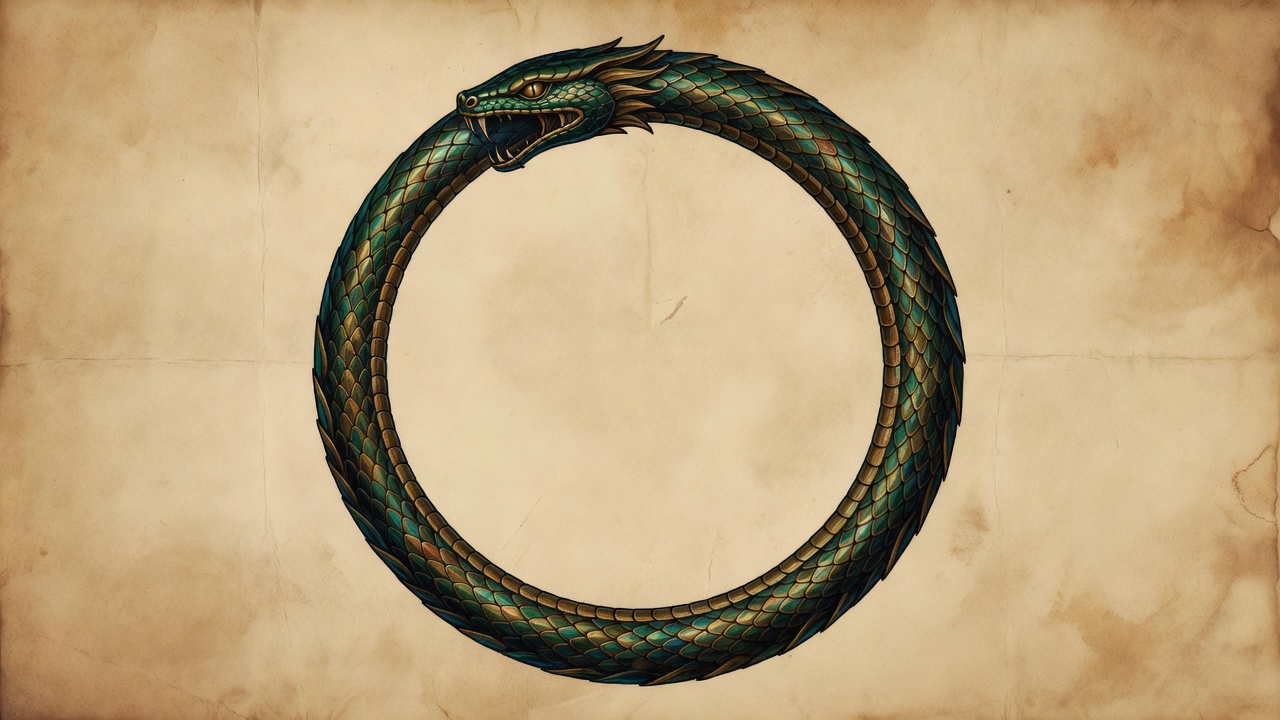
Why the same symbols recur
Two competing explanations dominate the study of recurring myth-symbols. The diffusionist view holds that trade, conquest and migration carried specific images from one culture to another — the spread of the winged sun disc from Mesopotamia across the ancient Near East is a well-documented example. The archetypal view, associated with Carl Jung and popularised by Joseph Campbell, argues that some symbols emerge independently because they encode universal human experiences: birth, death, cycles, the unknown. Most historians now favour a mixed model — some motifs travelled along real trade routes, others were independently invented because a coiled snake or a great tree are simply intuitive things to draw.
Five recurring symbols compared
| Symbol | Cultures | Names | Core meaning |
|---|---|---|---|
| Ouroboros | Egypt, Greece, Norse (variant) | Ouroboros; Jörmungandr | Cyclicality, eternity, self-renewal |
| World Tree | Norse, Siberian shamanic traditions, Mesoamerican | Yggdrasil; Ceiba; Axis Mundi | Connects underworld, earth and sky |
| Ankh | Ancient Egypt | Key of Life | Life force, divine breath |
| Triquetra | Celtic, later Christianised | Trinity Knot | Threefold unity (maiden/mother/crone or the Holy Trinity) |
| All-seeing eye | Egypt, Freemasonry, Buddhism | Eye of Horus; Eye of Providence; Buddha's eyes | Protection, omniscience |
Case study: the Ouroboros
The earliest known depiction of a serpent devouring its own tail appears in the Egyptian funerary text known as the Enigmatic Book of the Netherworld, inscribed in the tomb of Tutankhamun (c. 1323 BCE). The image reappears over a thousand years later in Greek alchemical manuscripts, most famously the Chrysopoeia of Cleopatra, where it symbolises the unity of matter. Centuries later still, Norse mythology describes Jörmungandr, a literal serpent deity encircling the world — a related image, but a distinct theological entity rather than an abstract symbol. Treating all three as "the same Ouroboros" flattens real differences in how each culture actually used the image.
Comparative mythology: useful lens or overreach?
What comparison reveals
- Shared human concerns — mortality, renewal, cosmic order — surface across unrelated societies.
- Tracing a motif's spread can reveal real trade and migration routes.
- Comparison highlights genuinely borrowed imagery, like the Hellenistic-Egyptian god Serapis, deliberately created to bridge Greek and Egyptian religion.
Where it goes wrong
- Folklorists have criticised Campbell's "monomyth" for smoothing over real theological differences between traditions.
- A visual resemblance is not proof of a shared origin or meaning.
- Local specificity — who worshipped an image, when, and why — is often the most historically important detail, and it's the first thing lost in "universal symbol" narratives.
How symbols actually travel
Documented mechanisms include conquest (Alexander's campaigns spreading Hellenistic imagery into Central Asia and India), organised trade (the Silk Road carrying Buddhist iconography from India into East Asia), and deliberate religious syncretism, where rulers merged local and foreign deities to unify newly conquered populations. Each of these leaves a different kind of evidence — inscriptions, coinage, temple remains — which is what separates a documented transmission from a speculative one.
Further reading
- Religious Iconography — how some of these motifs were later absorbed into organised faiths.
- Alchemical & Hermetic Symbols — the Ouroboros's second life in alchemy.
- Wikipedia: Ouroboros
- World History Encyclopedia
Think we've mischaracterised a tradition's own account of a symbol? Tell us — primary-source corrections are prioritised.