Sacred Geometry
Why triangles, spirals and circles carried divine meaning long before mathematics became a science — and how to tell a measured pattern from a marketed one.
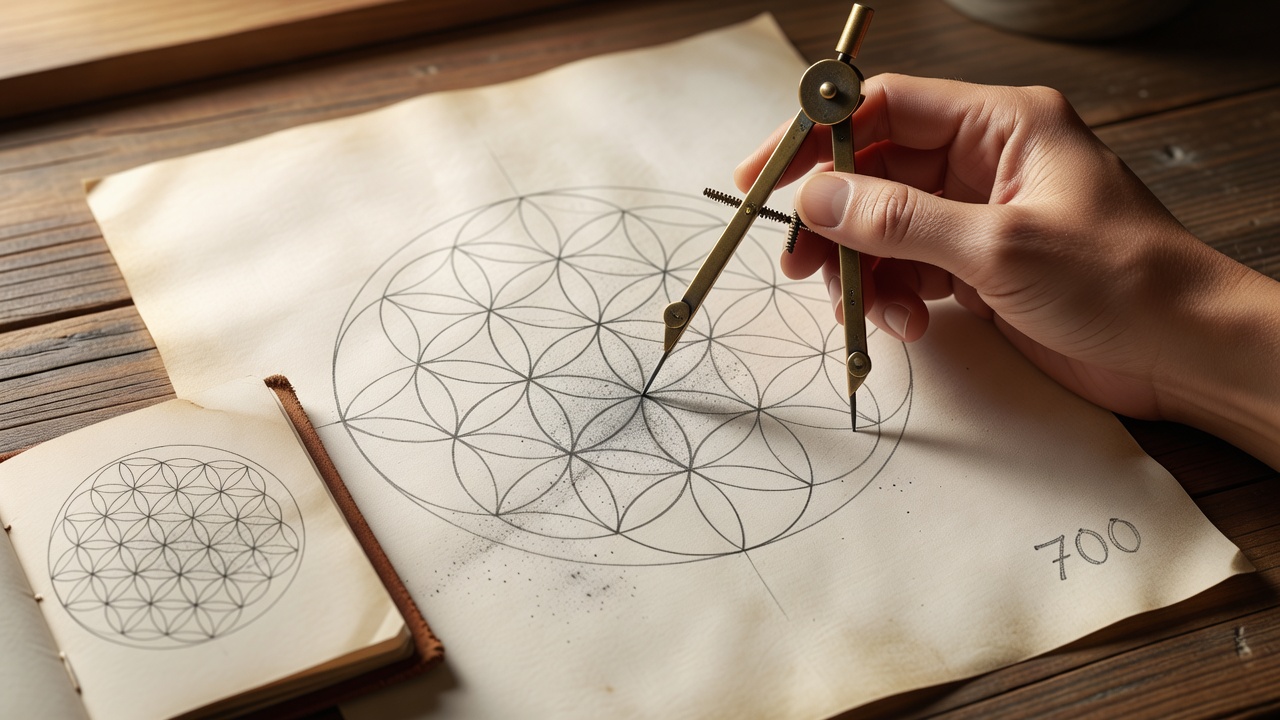
What is sacred geometry?
Sacred geometry is the belief that certain shapes, ratios and proportions — the circle, the triangle, the golden ratio, the hexagon — reflect an underlying divine or cosmic order. It shows up in temple floor plans, cathedral windows, Islamic tilework, Hindu yantras and, more recently, in wellness branding that borrows the aesthetic without the history. Treated carefully, it is a genuine window into how pre-modern cultures used mathematics as a form of worship. Treated carelessly, it becomes a grab-bag of unrelated symbols presented as one ancient secret.
Origins and history
The earliest deliberate geometric ornamentation appears in Neolithic passage tombs and Bronze Age temple carvings, but the philosophical framework most people mean by "sacred geometry" is Greek. Pythagoras and his followers, in the 6th century BCE, treated whole-number ratios as the hidden structure of music, astronomy and the soul. Plato's dialogue Timaeus (c. 360 BCE) assigned the five regular convex polyhedra — the tetrahedron, cube, octahedron, dodecahedron and icosahedron — to the classical elements and the cosmos itself, which is why they are still called the Platonic solids.
Centuries later, Islamic art turned geometry into its dominant visual language partly as a response to religious caution around figurative imagery, producing tessellated star-and-polygon patterns of extraordinary mathematical complexity from Córdoba to Samarkand. European Gothic builders encoded proportion into cathedral floor plans and rose windows. During the Renaissance, the rediscovery of Euclid and the popularisation of the golden ratio (later labelled "phi") reframed geometry as both a scientific and an aesthetic ideal, culminating in works like Leonardo da Vinci's Vitruvian Man. The most recent wave — the "Flower of Life" revival — is a 20th-century phenomenon, popularised from the 1980s onward rather than a continuous ancient tradition.
Core patterns compared
| Pattern | Also known as | First documented | Common interpretation |
|---|---|---|---|
| Flower of Life | — | Disputed; carvings at the Temple of Osiris, Abydos, Egypt, are of uncertain date | Interconnection of all life |
| Metatron's Cube | — | Derived from the Flower of Life, popularised in the 20th century | Said to contain the five Platonic solids |
| Vesica Piscis | "Vessel of the fish" | Prehistoric geometric use; formalised by Euclid, c. 300 BCE | Union of opposites; sacred feminine imagery |
| Golden Ratio (φ ≈ 1.618) | Divine Proportion | Euclid's Elements, c. 300 BCE | Aesthetic harmony, growth patterns |
| Sri Yantra | — | Hindu tantric texts, attested before the 11th century CE | Cosmos and the divine feminine (Devi) |
Mathematics vs. mysticism
What the evidence supports
- Measurable geometric ratios appear consistently in classical architecture, often for structural or aesthetic reasons.
- Islamic geometric ornament reflects documented mathematical sophistication, not folklore.
- Approximate — not exact — golden-ratio proportions do appear in some natural growth patterns, such as spiral shell curvature.
Where popular claims overreach
- Exact phi ratios claimed for the Great Pyramid or the human body are usually approximate and selectively measured.
- The "ancient Egyptian" dating of some Flower of Life carvings is contested; some may be Greco-Roman era additions.
- Presenting unrelated cultures' geometry as one shared "ancient secret" ignores that simple shapes are independently reinvented everywhere.
How we verify a claim
Before publishing a dating or meaning claim about a geometric motif, we check it against peer-reviewed archaeology rather than secondary wellness sources, distinguish between "this image exists" and "this image carried the claimed symbolic weight at the time," and flag where scholarly consensus is still unsettled.
Further reading
- Ancient Mythological Symbols — how geometric motifs like the vesica piscis intersect with myth.
- Alchemical & Hermetic Symbols — geometry's overlap with the Hermetic tradition.
- Wikipedia: Sacred geometry
- The Metropolitan Museum of Art: Geometric Design in Islamic Art
- Encyclopaedia Britannica: Golden ratio
Spotted an outdated citation or a dating claim that needs revisiting? Contact our editors — every correction is logged and reviewed.