Religious Iconography
How faith traditions codified the invisible into image — and why some forbade the attempt entirely.
A comparative table
| Symbol | Tradition | Earliest attestation | Meaning |
|---|---|---|---|
| Latin Cross | Christianity | Widespread after the 4th century CE, following Emperor Constantine | Crucifixion and salvation |
| Star of David (Magen David) | Judaism | Existed earlier as a general talismanic hexagram; adopted as a Jewish emblem from the 17th century | Jewish identity and community |
| Om (ॐ) | Hinduism, Buddhism, Jainism | Vedic texts, c. 1000 BCE | The primordial sound, the totality of existence |
| Dharma Wheel (Dharmachakra) | Buddhism | Ashokan pillars, 3rd century BCE | The Buddha's teaching and the eightfold path |
| Crescent and Star | Cultural Islam (not scriptural) | Widespread Ottoman adoption, 18th–19th century | Cultural and national emblem, pre-dating Islam in origin |
Iconoclasm vs. devotional imagery
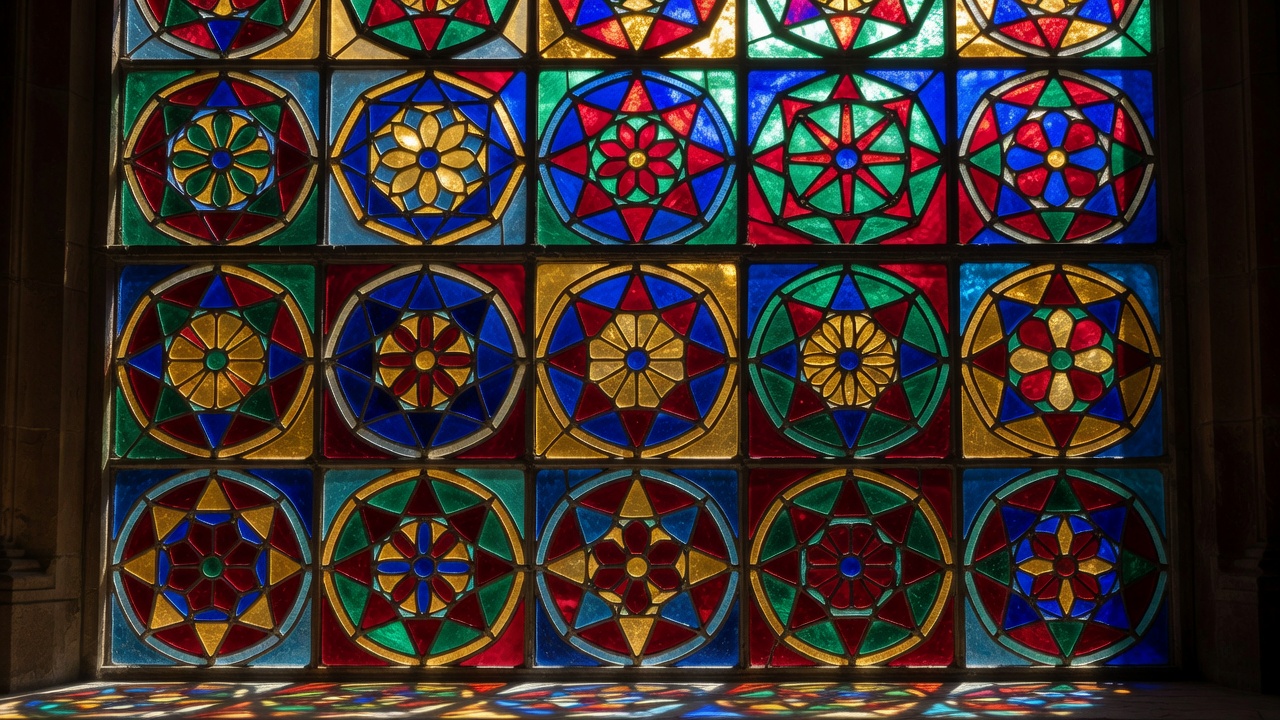
Religious traditions have never agreed on whether the sacred should be pictured at all. Byzantine Iconoclasm (726–843 CE) saw two extended periods in which the Eastern Orthodox Church banned and destroyed religious images, arguing that depicting the divine risked idolatry. Judaism and Islam both root a similar caution in scriptural prohibitions against graven images, producing rich traditions of calligraphy and abstract ornament instead of figuration. The Protestant Reformation triggered its own wave of image-breaking in 16th-century Europe, targeting Catholic statuary and stained glass as corruptions of true worship.
The case for restraint
- Avoids the risk of worshipping the image rather than what it represents.
- Keeps focus on text, teaching and the transcendent.
- Resists the commercial reproduction and trivialisation of sacred imagery.
The case for imagery
- Aided religious instruction in eras of widespread illiteracy.
- Preserves narrative memory — stained glass and icons functioned as visual scripture.
- Builds durable communal and cultural identity around a shared visual language.
When a symbol is politicised
The clearest case study in how context can override original meaning is the swastika. Originally the Sanskrit svastika, it has been a symbol of auspiciousness and wellbeing in Hindu, Buddhist and Jain traditions for over 3,000 years, and it remains so across South and East Asia today. Its appropriation by the Nazi Party in the 20th century irrevocably altered its meaning across most of the West, creating two entirely separate symbolic histories running in parallel — a reminder that a symbol's meaning is inseparable from who is using it, and when.
Reading icons responsibly
Our editorial rule is simple: describe a tradition's own account of a symbol before layering on outside interpretation, and never assume that two visually similar symbols from unrelated faiths share a meaning just because they look alike.
Further reading
- Sacred Geometry — the abstract geometric traditions that developed partly in response to figurative restrictions.
- Talismans & Amulets — devotional objects that sit alongside formal iconography.
- The British Museum
- Wikipedia: Religious symbolism
Working on a research project and need a citation checked? Get in touch.